During the three decades after World War II, for example, incomes in the United States rose rapidly and at about the same rate — almost 3 percent a year — for people at all income levels. America had an economically vibrant middle class. Roads and bridges were well maintained, and impressive new infrastructure was being built. People were optimistic.
By contrast, during the last three decades the economy has grown much more slowly, and our infrastructure has fallen into grave disrepair. Most troubling, all significant income growth has been concentrated at the top of the scale. The share of total income going to the top 1 percent of earners, which stood at 8.9 percent in 1976, rose to 23.5 percent by 2007, but during the same period, the average inflation-adjusted hourly wage declined by more than 7 percent. …
[Does income inequality matter? Yes it does] The counties where income inequality grew fastest also showed the biggest increases in symptoms of financial distress.
For example, even after controlling for other factors, these counties had the largest increases in bankruptcy filings.
Divorce rates are another reliable indicator of financial distress, as marriage counselors report that a high proportion of couples they see are experiencing significant financial problems. The counties with the biggest increases in inequality also reported the largest increases in divorce rates.
Another footprint of financial distress is long commute times, because families who are short on cash often try to make ends meet by moving to where housing is cheaper — in many cases, farther from work. The counties where long commute times had grown the most were again those with the largest increases in inequality.
The middle-class squeeze has also reduced voters’ willingness to support even basic public services. Rich and poor alike endure crumbling roads, weak bridges, an unreliable rail system, and cargo containers that enter our ports without scrutiny. And many Americans live in the shadow of poorly maintained dams that could collapse at any moment. …
But are there offsetting benefits?
There is no persuasive evidence that greater inequality bolsters economic growth or enhances anyone’s well-being. Yes, the rich can now buy bigger mansions and host more expensive parties. But this appears to have made them no happier. And in our winner-take-all economy, one effect of the growing inequality has been to lure our most talented graduates to the largely unproductive chase for financial bonanzas on Wall Street.
In short, the economist’s cost-benefit approach — itself long an important arrow in the moral philosopher’s quiver — has much to say about the effects of rising inequality. We need not reach agreement on all philosophical principles of fairness to recognize that it has imposed considerable harm across the income scale without generating significant offsetting benefits.
Saturday, October 16, 2010
Income inequality
It is significant, and now we can measure how bad it is. This is from an article by Robert Frank in the NYTimes.


Why hasn't Obama championed his own economic philosophy rather than parroting that of the Republicans?
According to the Washington Post,
Obama said that just as people and companies have had to be cautious about spending, "government should have to tighten its belt as well. We need to do it in an intelligent way. We need to make sure we do things smarter, rather than just lopping something off arbitrarily without having thought it through."As Paul Krugman pointed out,
We’ll never know how differently the politics would have played if Obama, instead of systematically echoing and giving credibility to all the arguments of the people who want to destroy him, had actually stood up for a different economic philosophy. But we do know how his actual strategy has worked, and it hasn’t been a success.That's one reason Obama's supporters are so angry with him. He simply hasn't stood up for what he said he believes—or at least what he led many of to think he believes. It's one thing to seek conciliation with the other side; it's another never to argue for what you believe.
Thursday, October 14, 2010

Monday, October 11, 2010
Bank Disinformation III: Obama Throws Weight Behind Banks, Housing “Market” Over Borrowers

Yves Smith of Naked Capitalism—who is really very good even though I wouldn't have guessed it from her conventional white-bread appearance—is all over the foreclosure crisis. She was of the people who unearthed and publicized it in the first place.
Team Obama is so predictably bank friendly that it was inconceivable that the Administration would ever decide against them on anything other than the occasional sop to maintain plausible deniability.
Sunday, October 10, 2010

I love Dean Baker!
From his blog, 
"Beat the Press"

"Beat the Press"
The top article in the Sunday Washington Post is an entirely invented piece that tells readers in the first sentence: 'If there is an overarching theme of election 2010, it is the question of how big the government should be and how far it should reach into people's lives.' There is absolutely nothing in this article that supports this assertion.
The article notes in the fourth paragraph that even most people who complain about the size of government consider Social Security and Medicare, by far the largest social programs, very important. It is not clear what being opposed to 'big government' means in a context where nearly everyone supports its main pillars.
There are no candidates anywhere in the country who are running in support of 'big government,' there are candidates who are running in support of programs which have varying degrees of support. There are many candidates (virtually all Republicans) who are running against 'big government.' While this position has nothing to do with the world (we all oppose waste, fraud, and abuse, the question is always the status of specific programs), it is certainly helpful to the Republicans to have the election framed in this way.
Saturday, October 09, 2010
Google Cars Drive Themselves, in Traffic

From NYTimes.com.
With someone behind the wheel to take control if something goes awry and a technician in the passenger seat to monitor the navigation system, seven test cars have driven 1,000 miles without human intervention and more than 140,000 miles with only occasional human control. One even drove itself down Lombard Street in San Francisco, one of the steepest and curviest streets in the nation. The only accident, engineers said, was when one Google car was rear-ended while stopped at a traffic light.
Brad DeLong points to this post by Karl Smith.
Really quickly, this Brian Westbury quote is brilliant because it is so perfectly, delectably wrong. Its the kind of thing you dream a student will say so that you correct the entire class’s misunderstandings in one fell swoop.Money for stimulus programs has to come from somewhere and he argues that stimulus spending is similar to the old adage: “borrowing from Peter to Paul.”Different professors will approach this different ways but I prefer to go at it like this:
“They (the government) either had to tax it from somewhere or borrow it from somewhere," says Wesbury and “by moving resources out of one sector into another you have now messed up the natural order of things and you’ve influenced it in a negative way."
Wesbury says THAT is the mistaken belief about government stimulus.
You’re exactly right Brian. The money has to come from somewhere. However, remember money and production are not the same thing. In the case of money, we have a technology known as the printing press which allows us to print money—as much money as we want. So creating money is no problem.
Won’t that cause inflation?
Yes, but we are below inflation targets right now, not above. We want more inflation. Right now the Fed is trying to get more inflation but is having trouble. Stimulus spending will help them out with that.
But, you can’t get something from nothing, can you?
No, you most certainly can’t. However, we aren’t getting something from nothing. We are getting something by combining together unemployed workers and idle factories. Remember a recession is a time when we have increasing unemployment and declining capacity utilization.
We have factories without workers and workers without factories. Those are resources that could be used to produce things but are not being used. If we can get those resources to work [we] will be able to make more things.
Unfortunately, we can’t, and ultimately it's because the economy doesn’t have enough money. Luckily we can print as much of that as we need.
Friday, October 08, 2010
Science Tarot
Neat idea!
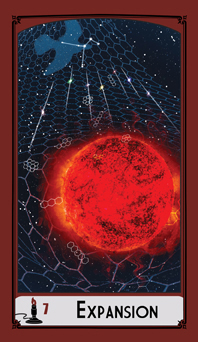
7 of Wands - Expansion
The red giant is at a great, expansive stage of the star's life and has grown to thousands of times its original size. Inner creation defines this moment in your life story as well.
The shell around the giant's collapsing core becomes hotter and starts fusing its hydrogen into helium, making the star brighter and the outer shells expand and grow cooler and less dense. Although fiery pressures mark the beginning of your journey, these expansive later years allow creation with a wider reach and a dense inner core.
We speak of "finding your voice" to describe this mature state. Other duties and diversions may fall by the wayside as work consumes the days filled with creation and productivity.
Hero's Journey, Step 7: Return with new knowledge into everyday life. The hero reveals a deeper determination.9 of Pentacles
9 of Pentacles - Aurora
Bright, mysterious lights wash across the night sky in one of nature's most beautiful displays: the Aurora Borealis, or Northern Lights.
A stream of energized particles from the upper atmosphere of the sun accelerate along the lines of the Earth's magnetic field, energizing the nitrogen and oxygen atoms floating here. The colorful glow comes from electrons shed by these excited atoms in our Earth's upper atmosphere.
The invisible stream of particles that pass continuously between the Sun and the Earth streak the night sky with spectacular radiant color. It is a brilliant yet fleeting display of beauty and transformation on a grand scale. Personal success is finally achieved, the old cast off in favor of the new.
Hero's Journey, Step 9: Death of old self, creation of the new self. From sacrifices have come great rewards.2 of Swords
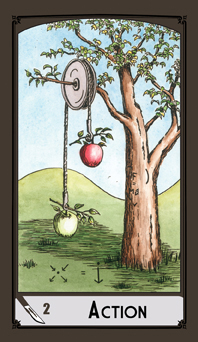
2 of Swords - Action
Sitting under the apple tree, we contemplate a choice to be made. The tree branch lifts an apple high in the air, and gravity continuously pulls it toward the ground. These equal and opposite forces hold the apple in place. But soon the balance may shift and the apple may fall, releasing the branch from its burden and shaking the leaves as they swing upwards.
Isaac Newton observed that every action caused an equal and opposite reaction and so reasoned that every reaction could be predicted from the action that triggered it. Like a game of billiards, Newton's world is a predictable knocking around of objects: the force of the impact equals the mass of the moving object times its acceleration. To send an apple flying in a specific direction, we only need to know where to hit it and how hard. To move a gigantic apple, we'll need to hit it with a great deal of mass, or we will need a running start.
A decision is hanging over your head. You can choose to leave the apple suspended in the tree, or you can apply enough force to bring it down. Either decision may bring good results, but if you wait too long, the apple may fall on your head.
Hero's Journey, Step 2: Refusal of the call. The hero is reluctant to use this new power.8 of Cups
8 of Cups - Cocoon
Encased within a protective cocoon during its transformation, the caterpillar utterly loses its form. Every cell takes on a new purpose, and for a time the creature is neither caterpillar nor moth. Only when metamorphosis is complete does the stunningly beautiful Luna moth emerge from its cocoon and spread its wings to the sky.
Times of transformation can demand a protective distance from the world, a total retreat. When the dissolution and recovery is complete, the world's challenges are not so threatening. Until that time, growth must take place in safe isolation.
Hero's Journey, Step 8: Defeating the dragon. The hero retreats from the world as deep changes unfold.3 The Empress
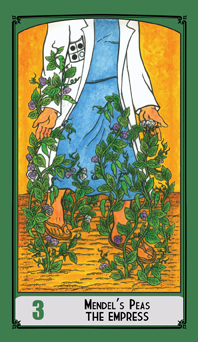
3 The Empress - Mendel's Peas
Gregor Mendel, a monk in the 1800s, experimented with pea plants, patiently nurturing them as they grew, withered and grew again in his garden. Curious about the passing of physical traits from parents to children, he chose to observe generations of pea plants, which produced hybrids he could easily cultivate. He watched for whether yellow or green pea pods, white or purple flowers and other selected qualities would be inherited from the parent plants.
Through this cycle of life, death and reproduction, Mendel uncovered the process of inheritance: how traits, dominant and recessive, are passed from parent to offspring. From these fruitful lifelong efforts, he became known as the Father of Genetics.
The Empress represents the nurturing attentiveness of Mendel as well as the natural processes he studied so closely and respectfully. This is a time for gestation, growth, patience and attention.


Subscribe to:
Posts (Atom)


