Saturday, August 15, 2009
Deficits and interest rates
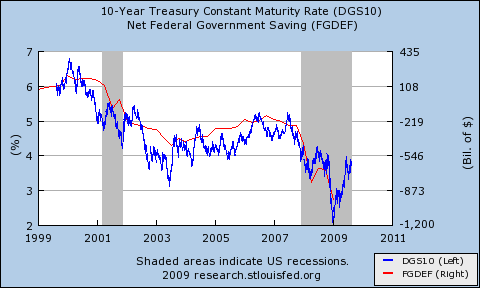
Paul Krugman found this relationship between federal deficits (red) and interest rates (blue). They are strongly positively correlated! They rise and fall together.


Fatty Foods Affect Memory and Exercise
From NYTimes.com
Eating fatty food appears to take an almost immediate toll on both short-term memory and exercise performance, according to new research on rats and people. …To determine the effect of a fatty diet on memory and muscle performance, researchers studied 32 rats that were fed low-fat rat chow and trained for two months to complete a challenging maze. The maze included eight different paths that ended with a treat of sweetened condensed milk. The goal was for the rat to find each treat without doubling back into a corridor where it had already been. The maze was wiped down with alcohol, so the rat had to rely on memory rather than sense of smell.
All of the rats studied had mastered the maze, finding at least six or seven of the eight treats before making a mistake. Some rats even found all eight on the first try.
Then half the rats were switched to high-fat rat chow (comprised of 55 percent fat), while the remaining rats stayed on their regular chow (which had 7.5 percent fat). After four days, the rats eating the fatty chow began to falter on the maze test — all of them did worse than when they were on their regular chow. On average, the rats on the fatty diet found only five treats before making a mistake. The rats who stayed with their regular food continued the same high level of performance on the maze, finding six or more treats before making a mistake.
Half of the rats had also been trained to run on a treadmill. After only a few days on the high-fat diet, the rats performed 30 percent worse on the treadmill. After five days of testing, the treadmill performance of the rats eating fatty foods had declined by half. The study results appear in The Faseb Journal, which is the journal of the Federation of American Societies for Experimental Biology.
“We expected to see changes, but maybe not so dramatic and not in such a short space of time,’’ said Andrew Murray, the study’s lead author and a lecturer in physiology at Cambridge University in Britain. “It was really striking how quickly these effects happened.’’
Although the human data aren’t yet published, the researchers have also performed similar studies of high-fat diets in healthy young men who then performed exercise and cognitive tests. Dr. Murray said he is still reviewing the data, but the short-term effect of a fatty diet on humans appears to be similar to that found in the rat studies.
It’s not clear why fatty foods would cause a short-term decline in cognitive function. One theory is that a high-fat diet can trigger insulin resistance, which means the body becomes less efficient at using the glucose, or blood sugar, so important to brain function.

Thursday, August 13, 2009
What do we want from government, and how do we want government to provide it.
In a previous entry I said the following.
A financial blog I read has this quote from P. J. O'Rourke. "Feeling good about government is like looking on the bright side of any catastrophe. When you quit looking on the bright side, the catastrophe is still there." It's that sort of sentiment that leads to the incompetence we saw in the Bush administration.My respondent said the following.
Humans are social creatures. We live in groups. We need ways to govern those groups. Pretending that we don't is worse than foolish. I discourages attempts to construct good governmental structures--which is not an oxymoron.
I would go so far as to say that actively promoting this sort of thinking is unpatriotic and harmful to the country. I wouldn't want laws to stop it, but I would certainly criticize people who engage in that sort of rabble rousing.
I agree that we need government, but my view is basically:I then replied as follows.
* small government is good, big government is bad
* market regulation is good, market interference (interference with the market price mechanism) is bad
* simple taxes (e.g. sales tax or VAT) are good, complex taxes like income tax are bad
The role of government is to provide a stable legal system, a stable monetary system, a sound infrastructure, to defend the country from external threats, and to keep their hands off everything else. In my view they have not done a very good job on any of these. Before I am labeled a right-wing neo-con I should clarify that I define "infrastructure" as including education and basic health care.
I think we are basically in agreement. The problem is that saying one wants small government seems to contradict saying that the government should provide a sound infrastructure and that a sound infrastructure should include a stable legal system, a stable monetary system, appropriate market regulation, education, and basic health care.
Doing a good job of providing that sort of infrastructure is not trivial. Certainly it's not something that one can just toss off by saying that the smaller the government the better. Besides that, it takes a fair amount of money to provide that infrastructure. That money has to come from somewhere. As I like to say, freedom isn't free; that's why we pay taxes.
So rather than saying "small government is good; big government is bad" or "taxes are bad" or even worse, "government is the problem not the solution" why not talk about the things we want government to do, acknowledge that there are quite a few of them, that they cost money, and that the money must come from somewhere, and then focus on the best ways to get them done and the best ways to finance them.
Independent prosecutor for torture memos?
The ACLU wants Eric Holder to appoint an independent prosecutor to investigate everyone involved in water boarding and other "enhanced interrogation techniques." This short video argues for that case.
I'm not sure I like the video, but I think getting it all out in the open with an independent prosecutor is a good idea. This shouldn't be a political witch hunt, but an independent prosecutor whose objective is to look into law violations seem like an appropriate approach.
You can support the call for an independent prosecutor at the ACLU website.
I'm not sure I like the video, but I think getting it all out in the open with an independent prosecutor is a good idea. This shouldn't be a political witch hunt, but an independent prosecutor whose objective is to look into law violations seem like an appropriate approach.
You can support the call for an independent prosecutor at the ACLU website.
Pitfalls of Self-Control
From Scientific American.
Researchers ran the participants through a series of computer-based mental exercises that are so challenging that the subjects temporarily deplete their cognitive reserves needed for discipline. Once they had the volunteers in this compromised state of mind, they put the group (and others who were not so depleted) into a social situation with the potential for racial tension. Here it is:
Each white subject is left alone in a room. A black man enters and asks if the volunteer will consent to a brief interview on the issue of how universities should guarantee racial diversity. … The interviewer asks the participant to share any thoughts he or she might have on this “hot topic,” and the conversation is recorded.
It was that simple, although sometimes the interviewers were white, to serve as controls. Afterward, the volunteers rated the interaction for comfort, awkwardness and enjoyment. In addition, independent judges—both black and white—analyzed the five-minute interactions, commenting on how cautious the volunteers were, how direct in their answers, and how racially prejudiced.
The results were provocative. As reported in the February issue of the journal Psychological Science, those who were mentally depleted—that is, those who did not have the energy to exert personal discipline and self-control—found talking about race with a black man much more enjoyable than did those whose self-control was intact. [Emphasis added] That outcome is presumably because they were not working so hard at monitoring and curbing what they said. It may seem counter-intuitive, but being cognitively drained made them less inhibited and more candid, which felt good.
And it wasn’t just the volunteers’ perceptions of the experience: the independent black observers found that the powerless volunteers were much more direct and authentic in conversation. And perhaps most striking, blacks saw the less inhibited whites as less prejudiced against blacks. In other words, relinquishing power over oneself appears to thwart overthinking and “liberate” people for more authentic relationships.
Discouraging good government
A financial blog I read has this quote from P. J. O'Rourke. "Feeling good about government is like looking on the bright side of any catastrophe. When you quit looking on the bright side, the catastrophe is still there." It's that sort of sentiment that leads to the incompetence we saw in the Bush administration.
Humans are social creatures. We live in groups. We need ways to govern those groups. Pretending that we don't is worse than foolish. I discourages attempts to construct good governmental structures--which is not an oxymoron.
I would go so far as to say that actively promoting this sort of thinking is unpatriotic and harmful to the country. I wouldn't want laws to stop it, but I would certainly criticize people who engage in that sort of rabble rousing.
Humans are social creatures. We live in groups. We need ways to govern those groups. Pretending that we don't is worse than foolish. I discourages attempts to construct good governmental structures--which is not an oxymoron.
I would go so far as to say that actively promoting this sort of thinking is unpatriotic and harmful to the country. I wouldn't want laws to stop it, but I would certainly criticize people who engage in that sort of rabble rousing.
The powerful and mysterious brain circuitry that makes us love Google, Twitter, and texting
This is a very interesting article by Emily Yoffe of Slate Magazine. It say that we (and other animals) have both a seeking/wanting center—it feels reward when we are seeking after something—as well as a traditional pleasure center. It's the seeking center that's so interesting.
See also, Berridge's website.
[It's existence] has implications for drug addiction and other compulsive behaviors. Berridge has proposed that in some addictions the brain becomes sensitized to the wanting cycle of a particular reward. So addicts become obsessively driven to seek [emphasis added] the reward, even as the reward itself becomes progressively less rewarding once obtained. 'The dopamine system does not have satiety built into it,' Berridge explains. 'And under certain conditions it can lead us to irrational wants, excessive wants we'd be better off without.' So we find ourselves letting one Google search lead to another, while often feeling the information is not vital and knowing we should stop. 'As long as you sit there, the consumption renews the appetite,' he explains.Not only can this seeking center lead us to endless hours on Google, email, blogs, twitter, etc. it can also explain why it's "hard to stop at just one," why flirting, sexual foreplay, and new sexual conquests are enjoyable. (It's not the conquest; it's the quest.) Taken to certain extremes (as in the addiction example mentioned) it also explains the pleasure in bondage and anorexia. And it explains why we are so fascinated with quest stories. Anticipation when drawn out the right way is almost irresistible. Although not always (as some of the examples above illustrate) it's often relatively harmless—although frequently a time waster.
See also, Berridge's website.
Wednesday, August 12, 2009
White Collars Turn Blue

Paul Krugman has a blog piece in which he refers to an article he wrote in 1996 predicting trends the century to follow. It's amazingly insightful, and probably seems more accurate now than it did then—except for the reference to a 500-channel world.

Subscribe to:
Posts (Atom)


