LA public transportation
I had my first-ever experience with Los Angeles public transportation. I'd been thinking of taking my bike to school and then taking the train home -- or vice versa. It was too cold (for me) even to take the bike to the station this morning, but I still wanted to see if I could navigate the public transportation system. I'd been putting it off for weeks and decided that today's the day. I had a meeting at school at 10 and used that as a target.
I left my house at 8:45 and drove to the MetroRail stop. (This is a test to see if I can put a link into a post in Blogger and have it come out as a link on Google+.) LA has two main public transportation systems: MetroRail, the light rail system, and MetroLink, which is heavier.
When I got to the station if found that they were paving the parking area. Half of it was closed off; the other half as full. No alternatives were provided. It took me 20 minutes to find a parking place and get back to the station.
I have a senior pass. (Getting it is another story!) For $1.80 I can ride all day on any train.
The train itself was amazingly slow. It never seemed to go faster than 35 miles/hour. It also seemed to stop at traffic lights as well as the dozen and a half stops between my stop and downtown. We did finally get to the other end of the line. Google had told me to switch to the Silver Line (a bus line) for the rest of the trip. Unfortunately it didn't tell me exactly where to find the bus stop. That took another 15 minutes. Eventually I got the bus and arrived at school only 45 minutes late. I could have made the entire trip by bike in less time.
The trip home was better. I caught every connection with no waiting. Even so, it took about an hour from the school station to my station. I would have taken about 1 1/2 hours by bike and 35 minutes by car.
I was particuarly disappointed in the technology. Most train systems now have ways for the train to know where it is and to display its location somewhere in the car. This one doesn't. All it shows is an old-fashioned map. There is also an audio announcement (if you can make it out) telling you which stop is next. Same thing at the stations. There is a crawl sign, but all it tells you is what the time is and not to walk on the track. Unlike most train systems these days it doesn't tell you how long it will be until the next train.
This was very disappointing. The Metrorail system is new. Yet the cars looked like the came from the 1980s and the technology matched.
Monday, March 11, 2013


Sunday, March 10, 2013
I was struck today at the extent to which computers are joining us in the physical world.
We were coming home from a friend's gathering. I used Google Maps to find a route and then turned Navigator on.
Debora was driving and didn't want to drive on the freeway as Google maps suggested. So got off the freeway we rode a main boulevard parallel to the freeway.
Google maps and GPS noticed we had gotten off the freeway and immediately rerouted us, telling us how to get back on the freeway. Of course we ignored its advice. It was very patient. At each new opportunity it told us to turn toward the freeway. At each opportunity we ignored its advice. I was quite impressed with how well it followed our position and continually updated what it decided was our best route. It was as if it was in the car with us and could see where we were.
Of course with GPS it did know where we were, but the sense of presence was much stronger than that. It was difficult to believe that it wasn't there in the back seat watching us drive. I was pleased that it was so patient with us even though we repeatedly ignored its advice. (If it had been a bit smarter it would have noticed that we were not getting back on the freeway and would have rerouted us back home on surface streets. It's not quite that smart yet.)
I recently saw an interview with Marc Andressen in which he talked about his vision of where technology is taking us. He talked about Mirror Worlds, David Gelernter's book of two decades ago, in which he say we will soon simulate the world in enough detail to be able to know what's going on by looking at the simulation. In addition the simulation will be well enough attached to the physical world that it will be able to keep the simulation up to date. That means we can both see pretty much all the real world as well as run experiments about possible futures with very little effort.
This seems to me to be one of the most important technological advances. It is super-augmented reality. The computer will be there in the world with us while at the same time having far greater reach of its sensors and computing capability.
We were coming home from a friend's gathering. I used Google Maps to find a route and then turned Navigator on.
Debora was driving and didn't want to drive on the freeway as Google maps suggested. So got off the freeway we rode a main boulevard parallel to the freeway.
Google maps and GPS noticed we had gotten off the freeway and immediately rerouted us, telling us how to get back on the freeway. Of course we ignored its advice. It was very patient. At each new opportunity it told us to turn toward the freeway. At each opportunity we ignored its advice. I was quite impressed with how well it followed our position and continually updated what it decided was our best route. It was as if it was in the car with us and could see where we were.
Of course with GPS it did know where we were, but the sense of presence was much stronger than that. It was difficult to believe that it wasn't there in the back seat watching us drive. I was pleased that it was so patient with us even though we repeatedly ignored its advice. (If it had been a bit smarter it would have noticed that we were not getting back on the freeway and would have rerouted us back home on surface streets. It's not quite that smart yet.)
I recently saw an interview with Marc Andressen in which he talked about his vision of where technology is taking us. He talked about Mirror Worlds, David Gelernter's book of two decades ago, in which he say we will soon simulate the world in enough detail to be able to know what's going on by looking at the simulation. In addition the simulation will be well enough attached to the physical world that it will be able to keep the simulation up to date. That means we can both see pretty much all the real world as well as run experiments about possible futures with very little effort.
This seems to me to be one of the most important technological advances. It is super-augmented reality. The computer will be there in the world with us while at the same time having far greater reach of its sensors and computing capability.
Wednesday, March 28, 2012
Thursday, July 28, 2011
Posting on Google+ for a while
I'm experimenting with posting on Google+. That means posts here will be minimal. If you want a Google+ invitation, let me know. (You can leave a comment below.)
Monday, July 25, 2011

Sunday, July 24, 2011
Can the Democrats make use of the Republican's irresponsibility?
They don't seem to be trying. Why don't I hear Democrats talking endlessly about how irresponsible it is of the Republican's to hold the country hostage by politicizing about the debt limit? To do so would require a bit of explanation. The Republicans have apparently convinced the public that not raising the debt limit is a good idea. And the Democrats are too politically incompetent to dispute that.
People are swayed by demagoguery, but they are also at least somewhat open to intelligent views. The Democrats should at least try it. They will never out demagogue the Republicans, so why not establish themselves as the party of clear thinking adults. There must be some sort of constituency for that.
People are swayed by demagoguery, but they are also at least somewhat open to intelligent views. The Democrats should at least try it. They will never out demagogue the Republicans, so why not establish themselves as the party of clear thinking adults. There must be some sort of constituency for that.

Wednesday, July 20, 2011
Congress Continues Debate Over Whether Or Not Nation Should Be Economically Ruined
WASHINGTON—Members of the U.S. Congress reported Wednesday they were continuing to carefully debate the issue of whether or not they should allow the country to descend into a roiling economic meltdown of historically dire proportions. "It is a question that, I think, is worthy of serious consideration: Should we take steps to avoid a crippling, decades-long depression that would lead to disastrous consequences on a worldwide scale? Or should we not do that?" asked House Majority Leader Eric Cantor (R-VA), adding that arguments could be made for both sides, and that the debate over ensuring America’s financial solvency versus allowing the nation to default on its debt—which would torpedo stock markets, cause mortgage and interests rates to skyrocket, and decimate the value of the U.S. dollar—is “certainly a conversation worth having.” "Obviously, we don't want to rush to consensus on whether it is or isn't a good idea to save the American economy and all our respective livelihoods from certain peril until we've examined this thorny dilemma from every angle. And if we’re still discussing this matter on Aug. 2, well, then, so be it.” At press time, President Obama said he personally believed the country should not be economically ruined.From (who else) The Onion
Government spending is for health care
 The conservative American Enterprise Institute notes that
 Between 1966 and 2007, the entire increase in the size of government relative to the economy resulted from growth in tax-financed health spending.
Median weekly earnings

Ouch!
According to Jared Bernstein, the median weekly earnings for full-time workers has fallen from $775+ to $755+ since 2009.
Tuesday, July 19, 2011

Meat Eaters Guide to Climate Change + Health
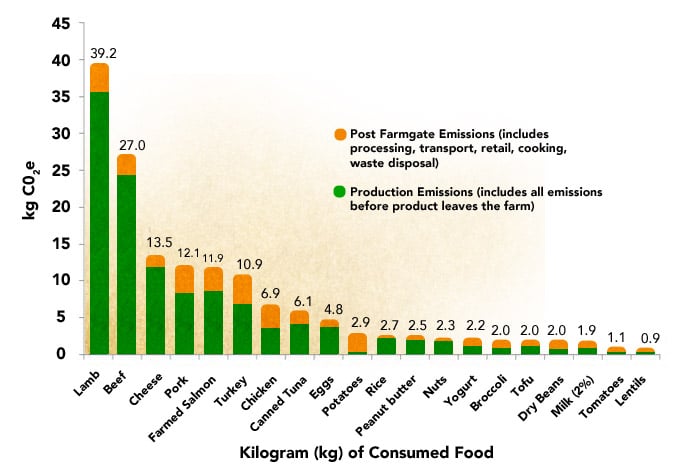
From Environmental Working Group. What not to eat: lamb and beef especially. More generally, most animal protein.
Monday, July 18, 2011
Incredible Shrinking Workers’ Income

David Frum notes that workers' share national income has collapsed and continues to do so.
It started with the recession at the start of the 80s. Reagan's presidency allowed it to stagnate at the recession level. During Bush I and Clinton I things got worse. Clinton's second term saw a partial comeback. But it's been pretty much downhill since then.
(Note that the Y-axis numbers are relative. 2005 is assigned a value of 100. Everything else is made relative to that.)
Sunday, July 17, 2011
Yes, Virginia, Our Housing Stock Is Now Way, Way Below Trend...

Brad DeLong notes.
That should be good news for home-builders. It hasn't happened yet, though. XHB, the Homebuiding ETF, has pretty much tracked the S&P 500 for the past year, except that it's a bit more volatile.
Our Broken Escalator
From Nick Kristof's column in the NYT.
The United States supports schools in Afghanistan because we know that education is one of the cheapest and most effective ways to build a country.
Alas, we’ve forgotten that lesson at home. All across America, school budgets are being cut, teachers laid off and education programs dismantled. …
The Center on Education Policy reports that 70 percent of school districts nationwide endured budget cuts in the school year that just ended, and 84 percent anticipate cuts this year.
In higher education, the same drama is unfolding. California’s superb public university system is being undermined by the biggest budget cuts in the state’s history. Tuition is set to rise about 20 percent this year, on top of a 26 percent increase last year, which means that college will become unaffordable for some. …
Granted, budget shortfalls are real, and schools need reforms as well as dollars. Pouring money into a broken system isn’t a solution, and we need more accountability. But it’s also true that blindly slashing budgets is making the problems worse. As Derek Bok, the former Harvard president, once observed, “If you think education is expensive, try ignorance.”
Still, we nation-build in Afghanistan and scrimp at home. How is it that we can afford to double our military budget since 9/11, can afford the carried-interest tax loophole for billionaires, can afford billions of dollars in givebacks to oil and gas companies, yet can’t afford to invest in our kids’ futures?
The Clash of Generations
From Tom Friedman's column in the NYT.
The generation that came of age in the last 50 years, my generation, will be remembered most for the incredible bounty and freedom it received from its parents and the incredible debt burden and constraints it left on its kids.
Lawmakers, Armed and Dangerous - NYTimes.com
From Frank Bruni's column in the NYT. Speaking of an Arizona legislator, State Senator Lori Klein, who pointed her gun at a reporter (perhaps accidentally)
Her Ruger is pink, like a Barbie convertible. Showing it to Ruelas [the reporter], she reportedly said, “Oh, it’s so cute.”Apparently the only state that still forbids concealed weapons is Illinois!
No, Senator Klein, it’s not. It’s a potentially deadly weapon. When are you and the rest of the country going to wake up to that?
Friday, July 08, 2011
Subscribe to:
Posts (Atom)


